Browse Items (79 items total)
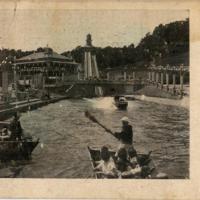
Luna Park was an amusement park in Arlington County in operation from 1906 to 1915.
The Park was owned and operated by the Washington, Alexandria, and Mt. Vernon Railway Company. The Company commissioned Ingersoll Company of Pittsburgh to build the park after Arlington Prosecutor Crandal Mackey closed Arlington's gambling houses. Fearing a drop off in patronage on their line, Luna Park was meant to act as a more family friendly draw. The Park featured water rides, side shows, and animal acts.
The architecture of the venue was Ionic. The style also had many international inspirations, including Egyptian, Byzantine, Moorish, Japanese, Arabic, Gothic, French, Renaissance, and Corinthian designs.
Like almost all recreation activities in Arlington at the time, Luna Park was segregated.
The Park was owned and operated by the Washington, Alexandria, and Mt. Vernon Railway Company. The Company commissioned Ingersoll Company of Pittsburgh to build the park after Arlington Prosecutor Crandal Mackey closed Arlington's gambling houses. Fearing a drop off in patronage on their line, Luna Park was meant to act as a more family friendly draw. The Park featured water rides, side shows, and animal acts.
The architecture of the venue was Ionic. The style also had many international inspirations, including Egyptian, Byzantine, Moorish, Japanese, Arabic, Gothic, French, Renaissance, and Corinthian designs.
Like almost all recreation activities in Arlington at the time, Luna Park was segregated.
Collection: Community Institutions
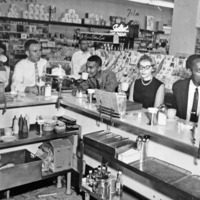
On June 23, 1960, after two weeks of coordinated sit-in efforts across the county, leaders from the Non-Violent Action Group (NAG) enjoy cups of coffee at the Drug Fair. The company announced the day before that it would integrate its lunch counters in the Washington area. Within weeks more restaurants and lunch counters in Arlington desegregated their services as a result of the sit-ins.
Those pictured include Dion Diamond (corner seat),Laurence Henry (far right), and Paul Dietrich (second from left).
Those pictured include Dion Diamond (corner seat),Laurence Henry (far right), and Paul Dietrich (second from left).
Collection: Civil Rights
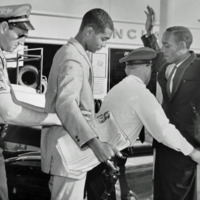
Non-Violent Action Group (NAG) activists Dion T. Diamond (left) and Laurence Henry are arrested by Arlington Police Sergeant Roy G. Lockey (left) and Lt. Ernest A. Summers. The two were arrested while demonstrating at the Howard Johnson's restaurant in Arlington.
This scene was a part of a coordinated sit-in movement which occurred across several Arlington lunch counters in June of 1960 to protest segregated accommodations. These demonstrations ultimately led to the integration of restaurants in Arlington. But unfortunately this did not end racism. African American resident Princeton Simms recalled that despite integration proprietors would “pick up the plate and throw it in the trash” after they were used by black patrons. This kind of outward hostility meant many black customers continued to prefer to patronize black owned restaurants despite integration.
This scene was a part of a coordinated sit-in movement which occurred across several Arlington lunch counters in June of 1960 to protest segregated accommodations. These demonstrations ultimately led to the integration of restaurants in Arlington. But unfortunately this did not end racism. African American resident Princeton Simms recalled that despite integration proprietors would “pick up the plate and throw it in the trash” after they were used by black patrons. This kind of outward hostility meant many black customers continued to prefer to patronize black owned restaurants despite integration.
Collection: Civil Rights
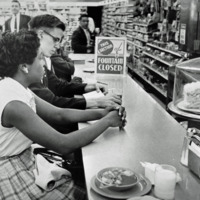
Gwendolyn Greene (later Britt) sits at the People's Drug Store Counter in Arlington Virginia. When she sat down to request service the workers left the store, only returning once management closed the counter.
This scene was a part of a coordinated sit-in movement which occurred across several Arlington lunch counters in June of 1960 to protest Arlington's segregated accommodations.
This scene was a part of a coordinated sit-in movement which occurred across several Arlington lunch counters in June of 1960 to protest Arlington's segregated accommodations.
Collection: Civil Rights
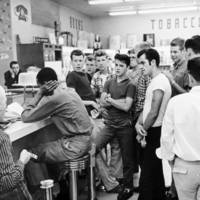
Non-Violent Action Group (NAG) activist Dion Diamond is harassed by young white men during a sit in at the Cherrydale Drug Fair in June of 1960.
This scene was a part of a coordinated sit-in movement which occurred across several Arlington lunch counters in June of 1960. to protest segregated accommodation.
This scene was a part of a coordinated sit-in movement which occurred across several Arlington lunch counters in June of 1960. to protest segregated accommodation.
Collection: Civil Rights
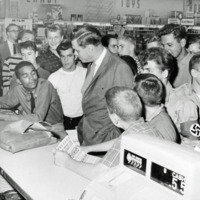
Non-Violent Action Group (NAG) activist Dion Diamond sits calmly as American Nazi Party Chief George Lincoln Rockwell attacks him with racist remarks. A crowd of white men and boys surrounds the pair.
This scene was a part of a coordinated sit-in movement which occurred across several Arlington lunch counters in June of 1960. Here, Diamond is at the Cherrydale Drug Fair sit-in location.
This scene was a part of a coordinated sit-in movement which occurred across several Arlington lunch counters in June of 1960. Here, Diamond is at the Cherrydale Drug Fair sit-in location.
Collection: Civil Rights
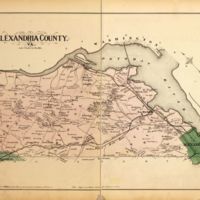
This map of Arlington County, then called Alexandria County, highlights Arlington's growing real estate developments.At the turn of the century Arlington was fast becoming a suburban enclave of Washington, D.C. Nearly two-dozen communities expanded or were formed at this time. This development encouraged and was encouraged by further rail-line development into the area.
Collection: Maps
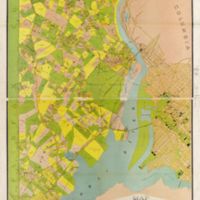
This map shows Arlington County as well as the District of Columbia and neighboring Virginia and Maryland counties. In the years after the Civil War, Arlington neighborhoods and trolley lines continued to form and expand. Increasingly these developments moved away from piecemeal, individual home building and toward large, centrally planned community developments.
Collection: Maps
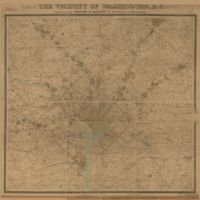
This 1878 map of Arlington County, then called Alexandria County, shows growing neighborhoods and trolley line development following the Civil War as the area transitioned from rural farmland to a more suburban environment.
Collection: Maps